
Preface
The Chronicle of the Saxons and Thuringians
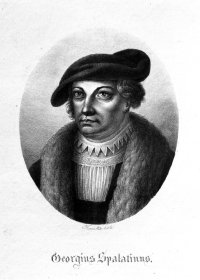
In 1510 Elector Frederick III of Saxony (1463–1525), known as Frederick the Wise and a member of the Ernestine branch of the Wettin dynasty, commissioned Georg Spalatin (1484–1545) to compile a comprehensive chronicle of the House of Saxony as it was conceived at the time. By 1515–1516 fair copies of the three completed volumes – today preserved in Coburg – had been produced, and these manuscripts were bound shortly thereafter in 1516–1517. Born Georg Burckhardt, he adopted the name Spalatin after his birthplace of Spalt near Nuremberg. Following studies in Erfurt and Wittenberg, he entered the Electoral Saxon court, an intellectual milieu strongly shaped by humanist scholarship. There he fulfilled a wide range of responsibilities encompassing educational, pastoral, scholarly, and diplomatic functions. Thanks to the position of trust he enjoyed at court, Spalatin also acted as an intermediary in communicating the ideas of the Reformation to Frederick the Wise, who would become the territorial protector of Martin Luther. From 1525 onward, Spalatin played a central role in the establishment and organisation of the Evangelical territorial church in Saxony.
Despite the widespread availability of printing with movable type, the chronicle itself was produced as a manuscript. Several scribes copied the text in an elegant chancery script. Responsibility for the visual programme lay with the Electoral Saxon court painter Lucas Cranach the Elder (1472–1553), a native of Kronach in Franconia whose workshop produced well over a thousand illustrations. Under the supervision of the master, the coloured pen drawings were executed by several artists working within the Cranach workshop. The overall design aimed at a deliberate unity of image and text. This is clearly reflected in the page layout, which follows humanist principles and typically presents a regular sequence of heading, image, and explanatory text.
In the Middle Ages and the early modern period, historical knowledge was commonly transmitted in narrative form and shaped by specific representational intentions. This does not preclude the possibility of extracting historically valuable information from such works through the application of modern methods of source criticism. Spalatin himself made considerable efforts to establish historical facts. Drawing upon an impressively broad range of materials, he conducted extensive source research and even incorporated German translations of Latin documents, inscriptions, and similar sources within the chronicle itself. Moreover, the text reveals early tendencies toward critical engagement with historical sources. Nevertheless, the boundaries between historically verifiable events and traditional narratives remain fluid, and chronological data are not always reliable. The primary purpose of the work was not the objective reconstruction of the past but rather the dynastic legitimation of the ruling house. Above all, the Chronicle of the Saxons and Thuringians reflects the representational ambitions of the Ernestine Wettin dynasty at the height of its political power.
Since 1423 the margraves of Meissen (attested since 1089) and the landgraves of Thuringia (since 1247) had also held the Saxon electoral dignity. Accordingly, they viewed themselves as heirs to earlier Saxon ruling dynasties, most notably the Ottonians (Liudolfings), to whom an entire volume of the chronicle is devoted. The narrative centres on individual rulers, and the structure of the work largely follows genealogical principles. Owing to the dynastic interconnections among European ruling houses, the narrative occasionally proceeds in a non-linear manner, moving back and forth chronologically. Within this overarching framework – applied with varying consistency – the chronicle presents a wealth of details concerning the lives and deeds of numerous historical figures. Spalatin was unable to complete the historical project, which had originally been conceived as a six-volume work. The chronicle breaks off during the reign of Elector Frederick I of Saxony (1370–1428), known as Frederick the Warlike. Consequently, the period of the author and his princely patrons – namely Frederick the Wise, his brother Duke and later Elector John of Saxony (1468–1532), known as John the Steadfast, and his nephew Elector John Frederick I (1503–1554), known as John Frederick the Magnanimous – was never reached as originally planned.
To this day the Chronicle of the Saxons and Thuringians has not been published in a complete critical edition. While the three finished volumes are preserved in the Landesbibliothek Coburg, a further chronicle volume together with extensive source materials is held in the Thüringisches Hauptstaatsarchiv Weimar. In Spalatin’s testament of 1535 these materials are described as loose illustrated paper gatherings consisting of six leaves each ("sexterns"). They were not bound into the present Weimar volume until 1681. The genesis and textual relationships of the manuscripts have been thoroughly investigated by Christina Meckelnborg and Anne-Beate Riecke on the basis of the extensive archival materials from Spalatin’s estate preserved in the Thüringisches Hauptstaatsarchiv Weimar. The transcriptions of the three Coburg chronicle volumes (Ms. Cas. 9–11) were prepared by Meckelnborg and Riecke on the basis of an earlier version commissioned by the Landesbibliothek Coburg. The transcription of the Weimar chronicle volume (Landesarchiv Thüringen – Hauptstaatsarchiv Weimar, Ernestinisches Gesamtarchiv, Reg. O 21) was newly prepared by the same scholars. Navigation within the digital edition is based on these transcriptions in combination with detailed tables of contents.
Silvia Pfister, 2006
Editorial revision: December 2025